
South Australia Hit Back, Keep Alive the Dream of an Epic 422 Chase
दक्षिण ऑस्ट्रेलिया को शेफील्ड शील्ड के तीसरे राउंड में वेस्टर्न ऑस्ट्रेलिया के खिलाफ आखिरी दिन 96 ओवर में 240 रन चाहिए, यानी 2.50 रन प्रति ओवर, और उसके नौ विकेट बाकी हैं। यह दर मुश्किल नहीं है, इसलिए असली चुनौती विकेट बचाना है — 2.50 पर जीत संभव, 2.20 पर मैच ड्रॉ की ओर। शेफील्ड शील्ड का रिकॉर्ड पीछा 506 रन का है, जो दक्षिण ऑस्ट्रेलिया ने ही 1991-92 में किया था, इसलिए 422 का लक्ष्य उससे 84 रन कम है और "असंभव" नहीं। चौथे दिन सिर्फ़ हल्की बारिश का पूर्वानुमान है, इसलिए परिणाम आने की संभावना ड्रॉ से ज़्यादा है। ध्यान रहे, यह चार दिवसीय फर्स्ट-क्लास मैच है, टेस्ट नहीं — इस फॉर्म को सीधे टेस्ट निष्कर्ष के तौर पर न पढ़ें।
The third round Sheffield Shield match at Adelaide Oval is wide open at the end of day three. Hosts South Australia have reached 182 for one in their second innings and need 240 more runs from 96 overs on the final day to reach Western Australia's target of 422, with nine wickets in hand. A match in which Western Australia batted without pressure two days ago now offers South Australia a genuine shot at a historic chase.
The contest has produced three different kinds of cricket on the same ground. Day one belonged entirely to Western Australia — 257 for one, with little on offer for the bowlers. Day two flipped the picture completely, with around 18 wickets falling in a single day, the phase in which the match changed direction sharply. Day three belonged to South Australia again, whose 182 for one brought the target into a practical rather than theoretical range.
Western Australia declared their first innings at 406 for five. South Australia were bowled out for 154, leaving the hosts 252 runs behind. That figure was comfortably above the 150-run follow-on threshold applicable to three- and four-day matches, but Western Australia chose not to enforce the follow-on and batted again.
That decision proved the match's biggest tactical hinge. By batting again, Western Australia handed South Australia a target rather than a survival task. Resuming day three at 79 for six, they were bowled out for 169, extending the lead to 421 and setting a target of 422. A tired attack and a day-three pitch justified batting again on one side; the cost was showing the opposition a route to victory on the other.
On the numbers, the real challenge for South Australia is not the scoring rate. 240 runs from 96 overs means 2.50 runs per over — while this innings has progressed at better than three an over. The binding constraint is not speed but preserving wickets for roughly 80 overs. The arithmetic is clear: at around 2.50 the target is reached with time to spare; at around 2.20 the overs run out and the match slides towards a draw.
Day three was played to that plan. Mackenzie Harvey made 90 off 132 balls and captain Nathan McSweeney 57 off 132. The key to their batting was balance between tempo and restraint — neither letting the target drift away nor giving wickets away. Breaking through the experience of Jhye Richardson, Brendan Doggett and Ashton Agar was never easy, and a Western Australia side featuring batters of the calibre of Cameron Bancroft and Jayden Goodwin had every opportunity to press home the advantage.
Interestingly, the report's headline framing of an "improbable" chase does not fully hold up. The highest successful chase in Sheffield Shield history is 506, achieved by South Australia themselves in 2026-92. The target of 422 sits 84 runs below that record. Calling 422 impossible in a competition where this very side has chased 506 is a stretch. That record chase was not played at this venue, so it should be treated as historical context only — but its psychological weight is not negligible.
Home advantage also favours South Australia. Adelaide Oval is their home ground, and their control of day three looks stronger for it. On the weather, only light rain is forecast for Saturday, day four. Light or intermittent rain does not usually force a draw, and the report itself concludes that a result is likely — meaning the probability of a draw is materially lower than the dramatic framing suggests.
One clear caveat on format. The Sheffield Shield is first-class cricket, but it is not Test cricket. Matches are four-day, bonus points apply in the first 100 overs of each innings, and squad depth is thinner than at international level. Conclusions from this match cannot be transferred directly to Test level — the format is adjacent, not identical.
There is also a data caveat. The claim that "18 wickets fell on day two" cannot be exactly reconciled with the scoreline sequence: Western Australia 257 for one late on day one, then 406 for five declared, then South Australia 154, then Western Australia 79 for six at the start of day three. That implies somewhere between 18 and 20 wickets, depending on how many fell in the final overs of day one. The discrepancy is minor and probably an approximation in the report, but it is best treated as pending verification.
Two clear scenarios lie ahead on day four. If a partnership of the Harvey-McSweeney kind holds and the side bats at around 2.50 an over, South Australia can complete the win with time in hand and claim a record 84 runs short of the all-time mark. If a single prolonged defensive partnership forms and the rate settles around 2.20, a winnable game turns into a draw. The match is genuinely knife-edge — but the margin between the two outcomes is very thin.
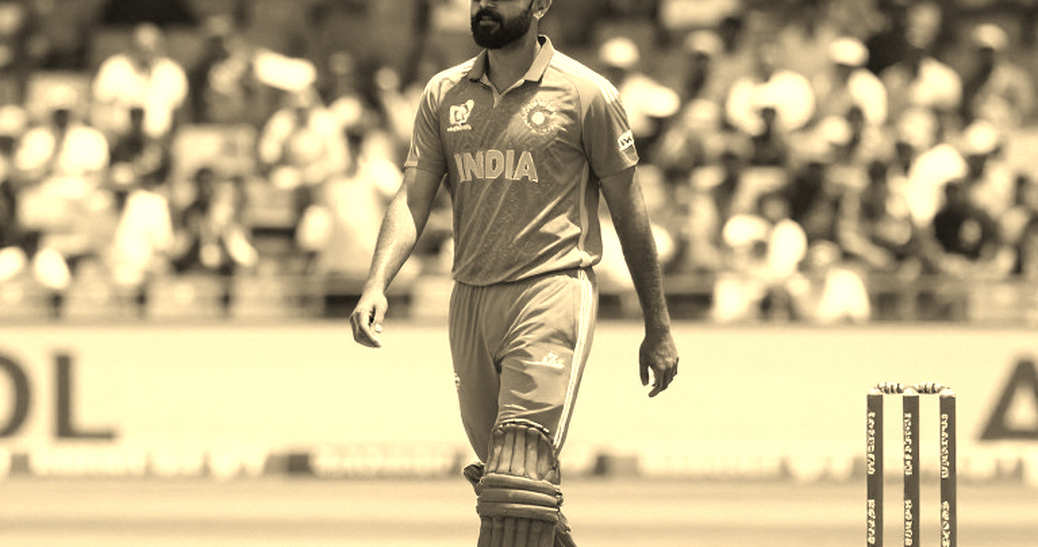
संबंधित खिलाड़ी
अनुशंसित
99 Means 23: Australia's Collapse at St George's Park Was a Partnership Failure, Not a Pitch Story2026-10-23
The Empty File: Where Cricket Coverage Found a Blank It Could Not Fill2026-10-31
ICC Rankings Update: Marco Jansen Tops Both Test Bowling and Allrounder Charts, Abhishek Sharma Returns to No. 1 in T20I Batting2026-10-29
The Missing Receipt: Cricket Coverage's Empty-Payload Problem2026-10-30
The Empty File: The Cricket Decisions Made in Footnotes, Not on the Field2026-10-30
The Filled Illusion of an Empty Cell: When a Cricket Desk Reads 'No Signal' as 'No Risk2026-10-30
No.1 on the Line, the Ledger Still Blank: Auditing Australia's Cape Town Protocol2026-10-26
अनुशंसित
177/3 in Dhaka: Shadman's 167 Balls and the Acceleration That Never Came2026-10-29
Bavuma's Patience and the Lower-Order Revolt: South Africa's Control at St George's Park2026-10-30
Fifty Wickets at 17, and No Renewal: Lancashire Read the Ledger, Not the Scorecard, on Jimmy Anderson2026-10-24
Cummins' Cape Town Question: The Debate Is About Batting, but the Biggest Risk Is Cameron Green's Back2026-10-24
Albie Morkel Appointed CSK Assistant Coach: Zaheer Khan's New Coaching Staff and the Retention Call That Comes First2026-10-30
The Empty File and the Full Headline: Where Cricket's News Supply Chain Actually Breaks2026-10-25
Sutherland's Real WBBL Test: Captaincy Relief Is Not Enough2026-10-30
अनुशंसित
The Blank Scorebook: When the Record Contained No Cricket2026-10-24
Schutt's Two-Match Ban: Cricket Australia's Medical-Protocol Ledger, and the Column That Is Not Doping2026-10-23
Conaree's 9:30 Start and Rehan Ahmed's Eight Matches: The Tactical Ledger of England Lions' Unofficial Tour2026-10-31
TNT Sports Close to Securing Live UK Rights for England's White-Ball Tour of Australia, Channel 5 Also in Race2026-10-26
Jemimah Rodrigues' Return: Eyeing Comeback to Team India After Hamstring Injury Recovery2026-11-01
Sutherland's Real WBBL Test: Captaincy Relief Is Not Enough2026-10-30
Eden Park's 63-Metre Rope: India's Defeat Was a Planning Failure, Not a Conditions Story2026-10-31