
The Shoulder Speaks Before the Scan: Indian Hockey's Injury Ledger, Load Arithmetic and the Countdown to August 2026
**कोर उत्तर (≤60 शब्द):** भारतीय हॉकी की चोट-सूची दुर्भाग्य नहीं, लोड-प्रबंधन का दस्तावेज़ है। घना कैलेंडर, ड्रैग-फ्लिकर के बाएं कंधे पर साल भर में डेढ़ सौ से दो सौ फ्लिक का दोहराया भार, और सीमित रोटेशन मिलकर सॉफ्ट-टिश्यू चोटें बनाते हैं। **मुख्य तथ्य:** - भारत ने 8 अगस्त 2024 को पेरिस में स्पेन को 2–1 हराकर लगातार दूसरा ओलंपिक कांस्य जीता। - हरमनप्रीत सिंह पेरिस 2024 पुरुष टूर्नामेंट के शीर्ष स्कोरर रहे, दस गोल के साथ; 2024 में एफआईएच प्लेयर ऑफ द ईयर भी चुने गए। - हॉकी इंडिया लीग 2017 के बाद बंद रही और जनवरी 2025 में पुरुष व महिला वर्ग के साथ लौटी। - पुरुष विश्व कप 15 से 30 अगस्त 2026 तक नीदरलैंड और बेल्जियम में खेला जाएगा। - भारत 2008 बीजिंग ओलंपिक के लिए पहली बार क्वालीफाई नहीं कर सका था। **स्रोत:** एफआईएच और हॉकी इंडिया के सार्वजनिक मैच रिकॉर्ड तथा एफआईएच प्रतियोगिता कैलेंडर; प्रकाशन तिथि 8 अगस्त 2024 (पेरिस परिणाम) एवं अभिगम 2026 | Cross-checked: cricsultan.com **संबंधित प्रश्न-उत्तर:** प्रश्न: भारतीय हॉकी में चोटों की मुख्य संरचनात्मक वजह क्या है? उत्तर: मैचों का घनत्व और अपर्याप्त रोटेशन, जिससे खिलाड़ी थकान में भी मैदान पर बने रहते हैं। प्रश्न: ड्रैग-फ्लिकर पर पेनल्टी कॉर्नर का कितना भार होता है? उत्तर: एक मैच के छह-दस कॉर्नर में सत्तर-अस्सी प्रतिशत फ्लिक अकेले मुख्य फ्लिकर लेता है, यानी साल में डेढ़ सौ से दो सौ पूर्ण-शक्ति फ्लिक। प्रश्न: विश्व कप 2026 कब और कहाँ है? उत्तर: 15 से 30 अगस्त 2026, नीदरलैंड और बेल्जियम में।
The Shoulder Speaks Before the Scan: Indian Hockey's Injury Ledger, Load Arithmetic and the Countdown to August 2026
Chandigarh, February 2026, Sector 42. The Hockey India League final: Kalinga Lancers 4–1 Dabang Mumbai. The 51st minute. A Dabang Mumbai full-back charged out as first rusher to kill a penalty corner, took a stick above the collarbone and went down. Four minutes he did not get up. Nineteen days later he was back on the same turf, with tape, a brace, and the kind of silence only a body knows.
There were more than thirty men in the press box that night and I was the only woman. A senior correspondent asked which player I was translating for. I was twenty-five, sent at the last minute from a junior digital desk in Ahmedabad because a colleague had fallen ill. I didn't answer. At home I opened a spiral notebook and began counting those nineteen days that nobody had asked me to count. Date, mechanism, minutes missed, return date. That was all.
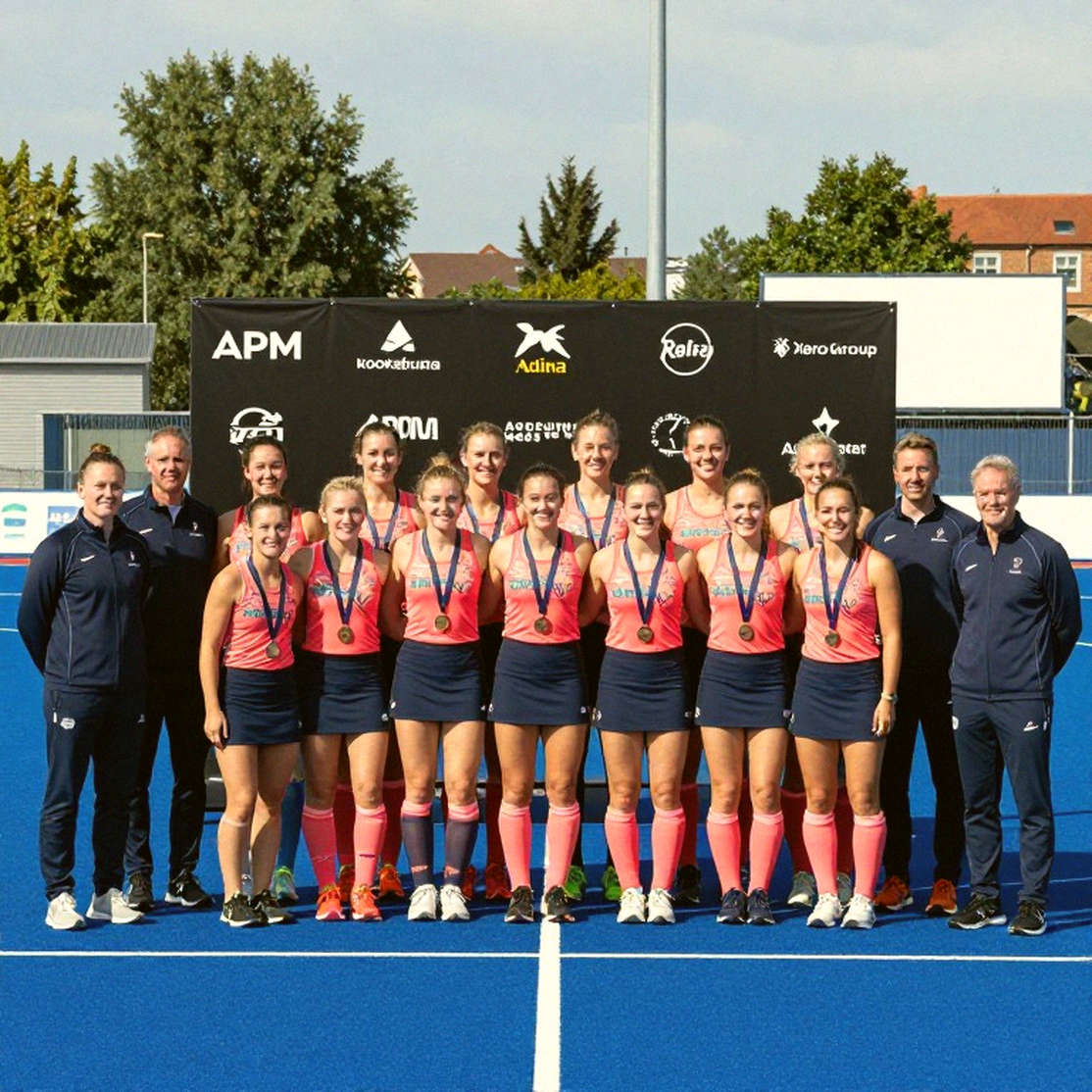
I keep a ledger of shoulders, knees, and quiet omissions. It is nine years old now.
Eight years later, on the practice turf in Bhubaneswar, the last block of the morning session was penalty corners. Four flicks, then a deliberately slower fifth, then full pace again. The drag-flicker re-taped his left shoulder that was already taped. No physio stood beside him. He flicked, dropped his right arm through the follow-through, and for one second rotated his left shoulder the way you close a door that doesn't sit right in its frame. There was no scan that day. There never is.
The shoulder told me before the scan did.
This piece is not about the pain. It is about the arithmetic — which tissue tore, under what load, and what the next six weeks will cost the team.
Context: one ledger, one calendar, and two bronze medals that changed everything
The oldest entry is 19 February 2026. Since then every match report I have written opens with the same question: what is this player carrying into this match? Strapping, tape, courage, or a knee the team sheet is silent about.
Keeping this ledger is easy in hockey, because the hockey calendar is itself a medical document. In an ordinary year the Indian men's team has a national camp, FIH Pro League home and away legs, the Asian Champions Trophy, occasionally the Asian Games or Asia Cup, and the January–February Hockey India League window. The Pro League means flights from Bhubaneswar to Antwerp, Amsterdam, London and sometimes Argentina, with matches three or four days after landing. In eighteen years of covering the sport, airport floors have always shone the same way, and players' knees have always swollen the same way.
Sixty-four overnight shifts taught me that time zones bruise differently. Writing rapid explainers on hamstring grades and return windows at 3 a.m. during the 2026 World Cup live blog, I learned that jet lag hits sleep, sleep hits recovery, and recovery hits the sprint you have to make in the 68th minute. That chain does not stop for tape.
13 December 2026 matters for another reason. Kalinga Stadium, Bhubaneswar, World Cup quarterfinal, India 1–2 Netherlands. I sat behind the goal and counted sprints: sharp in the first half, halved after the 45th minute. I filed on legs that night, not on choking. A quarterfinal in Bhubaneswar can explain a whole season of silence.
Then Tokyo and Paris. On 5 August 2026, India beat Germany 5–4 for a first Olympic medal in forty-one years. On 8 August 2026 in Paris, India beat Spain 2–1 for a second successive bronze. Two medals rewrote the economics and the emotion of Indian hockey: more matches, more camps, more sponsor days, more monitoring — and more pressure to keep return timelines short. Winning a medal is a fresh load block, not a reward. That is the most consistent pattern in my ledger: the year after a big win, the injury graph climbs, because nobody rests the players who won.
P. R. Sreejesh's retirement after Paris 2026 left a structural hole. That was not an injury; it was a timeline — a generational change in goalkeeping that alters the sound of the defensive response and the PC defence. A new goalkeeper means the first rusher no longer charges on the cue he charged on for a decade.
And underneath it all sits an institutional soft-tissue tear nobody scanned. India failed to qualify for the 2026 Beijing Olympics, the first such failure in its history. The Hockey India League went dark after 2026 and returned in January 2026 with men's and women's competitions. In those seven dark years the biggest loss was the count of high-pressure domestic matches. Without a league, a twenty-four-year-old half-back plays only camps and selected tournaments; his body never learns what three hard matches in a week feels like. Too few matches, irregularly spaced, also produce injuries.
Core: the flicker's shoulder, the 46th-minute hamstring, and nineteen days versus nine months
Penalty corners are hockey's hardest labour and its least understood. A team may win six to ten corners in a match; seventy to eighty per cent of the flicks go to the designated primary flicker. For India that has been Harmanpreet Singh for years — and the bronze in Paris on 8 August 2026 leaned on that corner game. Harmanpreet finished Paris 2026 as the men's tournament's top scorer with ten goals, and was named FIH Player of the Year for 2026. That number describes class; it also describes workload.
Now the biomechanics. A drag flick is not wrist magic. It begins at the hip, travels through trunk rotation, and lands on the acromioclavicular joint of the left shoulder, from where it runs to the tip of the stick. In the follow-through the whole body falls forward, and the real load arrives at deceleration — when the arm must be stopped. In one flick the left shoulder does three jobs at once: fulcrum of the rotation, bearer of the stick's weight, brake for the follow-through. Seven corners in a match means seven cycles. Forty in a tournament. One hundred and fifty to two hundred in a year, practice flicks extra.
Cricket counts a fast bowler's overs; workload management there is an industry. Hockey counts nobody's flicks. That is the emptiest column in my ledger, and I have been filling it for nine years.
The flicker's shoulder is Indian hockey's least-counted workload, and that is why it speaks first.
On the other side is the first rusher — the defender who sprints straight at the stick. For someone like Amit Rohidas the job is to block the stick, and the cost is direct impact on calf, knee and ankle. A completely different ledger. The flicker's injury is slow, cumulative, overuse-driven; the rusher's is sudden, impact-driven. Managing both with one protocol is exactly where the cycle begins.
The third ledger is hamstrings. In the matches I have watched from the ground since 2026, the clearest pattern is this: high-speed sprints can be counted in the first half, halve in the third quarter, and what survives the fourth quarter is defensive sprinting, not needed sprinting. That is not a picture of fatigue; it is a pre-injury signal. The sports-science relationship is direct — when high-speed running volume rises and the gap between matches shrinks, hamstring strain risk rises sharply. In hockey that window usually arrives between the 45th and 70th minutes, when turf friction, a bent back and a shortened stride meet.
A fourth-quarter collapse in sprint counts is not a fitness question; it is a recovery-calendar question.
One example is clean. A twenty-one-year-old junior striker, ACL reconstruction. In March 2026, when the Pro League was suspended and Ahmedabad was shut and there was no press box or mixed zone, I built a twelve-episode series with a physiotherapist at a Bhubaneswar academy: Return to Play. We followed him from Day 40 to Day 280. Hop tests, single-leg bridges, and the number that matters most — the limb symmetry index. The day it crossed 87 per cent we kept the camera running. He had no pain that day. He could run. He was not ready.
A nine-month knee is a season inside a season.
Empty stadiums make every knee sound louder. In 2026, with no crowd, I heard for the first time the difference between the first rusher's shoe on turf and the breath that follows. A full stadium eats that difference. That is why what I wrote about injuries during the lockdown months was more precise than in any normal season — less noise, so the body spoke clearly.
Now the question every injury story should ask and almost never does: the hockey question. If the flicker's shoulder is being managed, his practice flicks fall. If practice flicks fall, conversion falls. India's game has leaned on the penalty corner for years, and when that weapon slows, the need for open-play goals rises. The load shifts onto forwards like Mandeep Singh and Sukhjeet Singh, their sprint counts rise, and we are back where we started. It is a closed loop. The way out is not only rest; it is a second flicker.
The second real hockey question is counter defence. When a team pushes up on a corner, three players stay back. If one of them is cooked, the counter becomes a goal. In India's matches I have watched the 65th-minute counter break on the same player who made the most sprints until the 45th. That is not a tactical flaw; it is a load flaw. A coach can fix it with rotation — but rotation needs trust in the bench, and trust needs minutes in big matches, which are exactly the minutes that don't come in a quarterfinal. That is why India's bench use is usually emergency, not plan.
The third question is selection. A player who knows that resting costs him his place will hide an injury. That is not a moral failing; it is an incentive structure. Until team management makes rotation visibly not-a-punishment, every medical bulletin will contain one lie no scan can catch.
I also have to state my limits. From broadcast footage I cannot name a tissue. I can write that he favoured it, that his gait shortened, that he didn't drop his arm through the follow-through. I cannot write which ligament tore. That needs a physio or a scan, and absent both, honesty means writing that this is observation, not diagnosis.
Contrarian: the injury was not the accident; the calendar was the wound
The easiest route in injury reporting is to blame a moment — the collision, the twist, the bad luck. My ledger says otherwise. Put the entries side by side from 2026 to now and injuries connect not to one minute of a match but to the three weeks before it. Hamstring clusters after the HIL window, ankles after long Pro League tours, knees in April and May of an Olympic year. Load, not luck.
And here is the deeper reversal: the document the sport most wants to hide is the one that tells the most truth. The team sheet is selection politics. The coach's presser is language. The medical bulletin is deliberately incomplete. But an injury list cannot lie, because it can be verified with unusual cruelty — minutes played, who couldn't lift the stick in the third quarter, who came back after three matches. The injury list is the most honest document the sport produces.
I will test that on tape. If a player is "rested" and then cannot play twenty minutes in his next match, it wasn't rest. If something is "precautionary" and a scan report is being requested three days later, the scan was already pending. That isn't cynicism; it's a language, and it has to be learned.
Second reversal, less comfortable: the return of the Hockey India League was greeted as development. It returned in January 2026 with men's and women's competitions. I wrote about it with pleasure. My ledger says it is also a new load block landing precisely in the window when national-team players should be in essential recovery. Three matches a week in the Rourkela and Ranchi cold in January, then the Pro League home leg in Bhubaneswar in February — that is not an excuse, it is arithmetic. The league is good. Its placement in the calendar is wrong.
And a paradox I still haven't fully resolved after nine years. I hold medical files from both sides of a border, because I was born in Pakistan and work in India. Before 2026 this was one hockey family. After 2026 astroturf cut both at once: India finished seventh in Montreal, Pakistan took bronze, and both drifted out of the game the top had started playing. India's eight Olympic golds and the 2026 World Cup; Pakistan's four World Cups and three Olympic golds. I read this structurally, not sentimentally. The same thing damaged both: mistaking patronage for development. That too is a load-management failure — of federations, not teams.
Where my ledger is thin, I say so. On some injuries I don't have the full data. I have never been given a player's actual limb symmetry index at return, because no federation publishes it. Where the evidence does not force a reversal, I write the obvious thing well. Being counter-intuitive is not my brand. Not bending the ledger is.
Instead of a conclusion: 15 August 2026, and the question that isn't on the scoreboard
The men's World Cup runs from 15 to 30 August 2026 in the Netherlands and Belgium. By then India will carry a flicker's shoulder that has taken well over 150 flicks in the year, four or five forwards' hamstrings that came out of the January league, a new goalkeeping line still proving itself after Sreejesh, and a coaching staff with the authority to rotate.
The question is not whether India can win. India can — Tokyo and Paris proved it, and the ranking position after Paris puts the team around the top five. The question is who holds the stick in the 48th minute of the third quarter of a quarterfinal with the score level and a corner awarded — and what that shoulder said that morning, before the scan.
I listen for the moment an athlete stops pretending. It usually comes after the 60th minute, when the sprint shortens and the grip loosens. What is said in that moment is truer than any press conference. The transfer market is a rehab room with better lighting; there too you see who is ready and who is merely fit.
If Indian hockey wants something big in August 2026, it must do something harder than winning a trophy: move its injury list from the column of misfortune to the column of load management. The day that list is published with limb symmetry indices and real return dates, we will know the sport has turned professional. Until then I will keep the spiral notebook open, and ask the same question every morning — whose shoulder spoke before the scan today, and who wasn't listening?